One-Ballot Rating System

(In this post, I discuss Instant Runoff, things I’ve discovered about this voting system, and my proposal for a better option. Scroll down to the example ballot to cut to the details of my one-ballot rating system.)

Despite many complaints, and the malfunctions that can be expected, many people in the year 2020 want to give Ranked Choice / Instant Runoff Voting a try. So I decided to find out if I might offer the people a better ranking system.

In seeking to make the system accurately reflect the will of the voters, I realized the core problem is:
Instant Runoff is a vote-for-1 system.

Ranking candidates makes people feel better, but only one vote at a time is counted from each voter. This insufficient use of data sometimes causes the elimination sequence to not make sense.

IRV Malfunction Example
Bush 37% 1st, 14% 2nd choice votes
Clinton 42% 1st, 5% 2nd
Perot 21% 1st, 56% 2nd
Left blank 25% of 2nd choice

IRV eliminates Perot first, it’s not even close.
IRV winner: Bush 51%.
This is arguably better than a basic vote-for-1, in which the spoiler effect would elect Clinton.
But who is really most popular?

Check Condorcet:
Bush:Clinton 51:42 – Bush
Bush:Perot 37:49 – Perot
Clinton:Perot 47:49 – Perot
Perot is the Condorcet winner, because he is preferred over the other candidates in head-to-head matchups.

Check who didn’t vote for them:
Bush 49% (51% voted for him.)
Clinton 53% (47% voted for him.)
Perot 23% (77% voted for him.)

Again, IRV eliminated Perot before the final two, even though he would beat Bush and Clinton in the final two.

In a similar dysfunctional way, IRV could eliminate the voters’ overall favorite candidate before the top four or five. Counting only one vote per ballot is Instant Runoff’s greatest weakness.
– –

So I tried adding different features to Instant Runoff. I wanted to make the system use more data from each voter.

One of my better ideas was counting two votes at a time, either counting every 1st and 2nd choice in one round, or using each ballot’s two highest-ranked qualifiers in multiple rounds.

For example, the procedure could be:
1. Count 1st choice votes, a candidate over 50% wins.
2. Narrow the field to the 4 candidates having the most 1st+2nd choice votes. (That’s vote-for-two. Would make a nice primary.)
3. Narrow the field to 2 candidates by counting the votes for every voter’s two highest qualifiers. (That’s counting up to 2 votes from each ballot.)
4. Relative rankings on each ballot determine the winner. (That’s 1 vote per voter who ranked either finalist.)

Then I thought maybe a person’s three highest-ranked qualifiers could work if there are many candidates, or count everyone’s 1st, 2nd, and 3rd choices.

Then it seemed right to make a third choice worth less, maybe a half vote.

Then I realized I was making a Scoring system, a more precise way of analyzing voter preferences.

Scoring systems are easier to count and recount than Instant Runoff.

Scoring allows an opinion to be expressed about every candidate. IRV does not.

Scoring allows us to rate two candidates as the same. IRV does not.

When IRV would shut him out, Scoring could help a very popular 3rd candidate who was just a little short on 1st choice votes.

Scoring considers the 2nd preferences of the voters whose 1st choices are in the Top 2. Instant Runoff ignores that information.

Final decision on Ranked Choice / Instant Runoff:
It can work well for finding the better of two candidates, and that’s about all it’s good for.

A good Score voting system will be much better than IRV. (It will also spare me from trying to explain why vote-for-2 makes so much sense. It just does.)

So here’s my suggestion for gathering the most data, and finding the right winner, if it must be an easy-to-understand, one-ballot election.

(Thanks to the people who created STAR voting, who did a lot of the work for me.)

Example ballot:

Score3

MALOLEY’S RATING SYSTEM
with point values 4-3-2-0,
Ranked Top 2 runoff,
and Worst-candidate disqualification:

All candidates can be assigned a rating, all ratings can be used multiple times, except “Worst” can be used only once.

Voters can select from three different ratings for favorable candidates. Each rating has a corresponding point value for determining the finalists (Top 2), and a rank, for determining which of the final two candidates is more popular.

Voters should give a favorable rating only to candidates they want to win. The favorable ratings are:
– Excellent, 4 points
– Good, 3 points
– OK (Acceptable), 2 points

Voters can also rank candidates of whom they do not approve, without giving them any points. This allows voters who dislike both of the Top 2 candidates to choose between them.

The unfavorable (don’t want to win) rankings are, from high to low:
– Neutral, 0 points (mild dislike, unknown, or not marked)
– Bad, 0 points
– Worst, 0 points (Limit one Worst vote per ballot)

“Worst” indicates a special disapproval, the sole candidate that the voter wants to lose to every other candidate.
A rank of “Worst,” given to one candidate by more than half the voters (a true majority) will eliminate the candidate, regardless of score.

Procedure:
1. A candidate who has “Worst” votes from more than half of the voters will be disqualified.
2. Point totals qualify the two highest-scoring candidates (but not a disqualified one) for the Top 2 runoff.
3. Rank on each ballot determines which of the Top 2 is preferred by more voters, and is therefore the winner.

One last note on step 3, the Top 2 runoff: This is to guarantee the winner is the more popular of the top two. The runoff uses the ranking of candidates on each ballot, so it would require the same equipment or programming necessary for Instant Runoff. Without that capability, the Top 2 would have to be dropped, “Bad” and “Neutral” would be merged into one rating, and the winner would be the one with the highest score, which will almost always be the most popular candidate anyway.

Or, use a primary to narrow the field to 3 or 4, and use Head-to-head matches for the Top 2 instead of ranking. Without the primary, there could be too many candidates to list all the possible combinations. Click this link for the article on Head-to-head matches. https://americarepair.home.blog/2020/01/17/head-to-head-matches-make-a-better-instant-runoff/

Variations of Approval and Head-to-Head

The Legislature column in the chart shows what Nebraska calls its “nonpartisan unicameral” election. A constitutional amendment, approved in 1934, requires nonpartisan elections for the office of state senator. The party affiliations of candidates are not listed on ballots. The top two in the fall can be two candidates of the same party. Again, we’ve been using a unified primary and a top-two for decades.

(Turn phone sideways or zoom in.)

Neb compare

The other four columns show proposals, extensions of these concepts, submitted for your Approval (Approval Voting). These are not just for Nebraska, so please implement wherever you like.

The rule of “one per party may advance” in federal elections is to make sure voters have some variety of options, instead of just a big field of Republicans. This could also motivate Democrats to run as Green, or Labor, etc, or as independents (no limit on independents). However we do it, we should make domination of our government, and our minds, a little harder for the Big 2.

It has come to my attention that in proportional representation systems (multiple winners), approval voting is not used, because it would tend to defeat the proportional concept. I have reviewed my previously proposed system of vote-for-2, top-4 semifinal, and head-to-head final, and it should work fine. But when sending only 3 to the semifinal round, I now support a vote-for-1 primary, as shown in this chart.

The previous blog post, about an approval-heavy voting system, has more info and a sample ballot with this head-to-head matches concept. https://americarepair.home.blog/2020/01/17/head-to-head-matches-make-a-better-instant-runoff/

Head-to-Head Matches Make A Better Instant Runoff

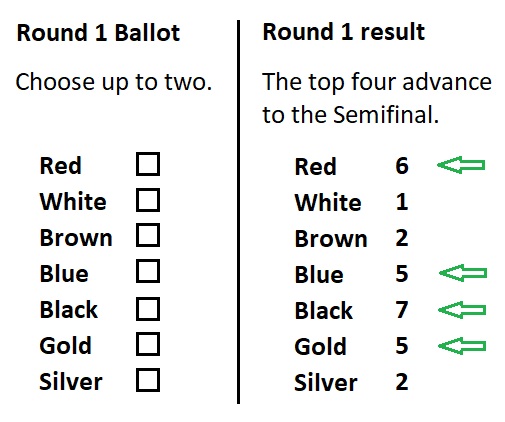
A boss wants his employees to choose a color for the new company van. And he likes accurate elections.

If using a simple plurality (as many states do in elections for high office), black is the winning color, with only 7 votes out of 28.

Allowing people to provide more information about their preferences will allow them to arrive at a better consensus.

The above ballot will be used as a primary. A 2nd ballot is created, with two sections.

The Approval vote is the Semifinal. The Head-to-Head section determines the people’s favorite of the final two.

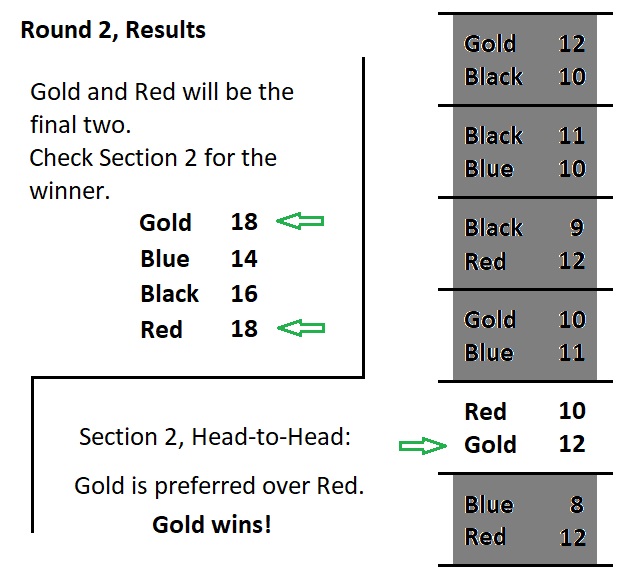
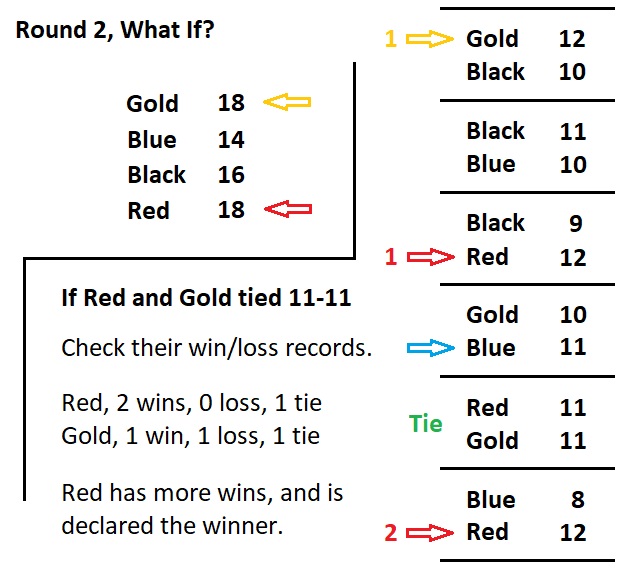
Below is an example of a tied Final match.

A procedure will be created for resolving ties, but a total vote count in section 2 should not be used, so there will be no downside in voting for a bad candidate over a worse one.

The van color voters might think their boss is crazy. But for high office, governor, congress, and president, this system would be ideal.

Head-to-Head Matches allow Semifinal and Final rounds on the same ballot.

Elections can and should gather more data from the people, to accurately measure their true will.

Many Americans are embracing ranked choice, also known as instant runoff, as a better system than plurality. But ranked choice is not all it’s cracked up to be, and the instant runoff aspect is largely false advertising. Approval would be better, or a point system such as Star voting.

I’ll leave it to you to research these systems if you wish. But a system with a Semifinal and Final on one ballot would be hard to beat, and simple enough for use in the real world.

An open primary, allowing each voter to select up to two, to narrow the field to the top four candidates, maximum 1 qualifier per party. (Bye bye, bipolar B.S.)

A fall ballot that provides for a semifinal and a REAL runoff final. The semifinal lists the top four, and allows each voter to choose as many as they wish. The final is one of the six possible head-to-head matches of candidates, and voters may select 1 per match. (Five of the six matches will usually be disregarded, since just one match involves the top two.)

(Smaller states and congressional districts might prefer 3 candidates in the semifinal, which will make only 3 possible head-to-head matches.)

The winner is the one with more votes in the head-to-head of the final 2.

Here’s a link to my other blog post with more philosophy on this voting system. Maybe skim it.

https://constitutionrepair.blogspot.com/2019/11/a-real-instant-runoff.html?m=1

(This article previously included an erroneous reference to Louisiana’s “jungle primary,” which is a one-round election if one candidate gets over 50%, otherwise there’s a second, top-two round. The system is being actively pushed in other states too, with a main selling point being cost savings. But it is important to spend the few bucks it costs for a second ballot every time, for the sake of ACCURATELY measuring the people’s will, with minimal spoiler effect.)

Brief Summary 2022 Tax Plan

These are all numbers for single filers.

Payroll tax will be flat, not regressive.
Employer, Employee, both 4%
Self-Employment, 8%
All payroll tax will be 100% deductible for income tax.

A $400 payroll tax credit that phases out between labor income of $53,000 and $58,000.
A $2000 senior tax credit, starting at age 61, that offsets any federal tax.

$8000 standard deduction,
Up to $10,000 taxable, 15%
Up to $45k, $1500 + 19% over 10k
Up to $130k, $8150 + 30% over 45k
Up to $270k, $33,650 + 39% over 130k
To infinity, $88,250 + 47% over $270k

Go back to using exclusions for capital gains, meaning a portion of gains is taxed as regular income.
Short term and dividends, 15% exclusion.
Medium term, 2 – 4 years, 30% exclusion.
Long term, 45% exclusion.

Here is the full proposal, with discussion following: https://americarepair.home.blog/2019/08/01/2022-tax-proposal/

Improving Elections With Vote-For-2

Proposal 1:

Every voter shall be permitted to select up to two candidates or two tickets per field of candidates, in primary and general elections, for President, Congress, and Governor.

Proposal 2 :

Primary elections for Congress and Governor shall list on one unified ballot all qualifying independent and partisan candidates for one office, and the general election ballot will include for each office only the three candidates or tickets that received the most votes in the primary, and one write-in line.

Proposal 1 would be good even without proposal 2. Three-way races would develop naturally, with the danger of vote-splitting minimized.

Adoption of proposal 2 would not be so good without proposal 1. But as an initiative by petition, it could inspire the state government to approve Vote-for-2 in at least the general election, to guard against vote-splitting.

Letting people vote for two, the one simplest change we could make, would do worlds of good.

The two-party system would become a more-than-two-party system, all on its own.
No more lesser of two evils. 
No more “don’t throw your vote away.”
No more spoilers.
No more top two, who only need to destroy the other one to win. 
More positivity.
More voter participation.
More candidates. 
More expensive for the powers-that-be to control them all.
More accuracy.
More democracy.

2022 Tax Proposal

(For a short summary: https://americarepair.home.blog/2019/09/09/summary-of-2022-tax-plan/ )

The national debt is real debt, and there is no magic fix. You know there will be consequences when you always go deeper into debt. You know it’s wrong to make your grandchildren pay for what you buy. You might not live to see it, but your kids could experience a crisis that will leave the U.S. dollar worth less than a Canadian nickel. When that happens, the little people, who don’t have vast assets of real estate and gold, will be the ones who get clobbered. We must raise revenue to leave future generations a fiscal outlook as good as the one we inherited.

The “Tax Cuts And Jobs Act” didn’t touch the tax that directly affects JOBS, the payroll tax. Huge corporations got a huge tax cut, but self-employed middle class workers are still taxed at rates that would make millionaires cringe. The president and congress slashed taxes for 2018, and blew up the deficit, to get corporate donations, and buy votes. I have a better plan for tax year 2022, to buy a future for the U.S. middle class.

Objectives of the 2022 Tax Plan

Lower the unfair payroll tax.
Eliminate the regressive aspect of social security tax, the tax cap.
Let the trust funds expire, and fully fund Social Security and Medicare with general fund money.
Steepen tax bracket graduations because taxes are too flat overall.
Raise income tax rates, but cut taxes on low income workers. (Lower than 2018)
Keep taxes on middle class workers lower than Obama era. (Lower than 2017)
Raise capital gains tax, especially the outrageous 0% bracket.
Eliminate the separate tax brackets for capital gains and dividends.
Lower the standard deduction in fairness to people who should itemize.
Allow poor and middle income workers a $400 non-refundable payroll tax credit. (Tax credits work like a 0% tax bracket for lower middle class incomes.)
Allow a $2000 non-refundable tax credit for senior citizens, that will apply to both income tax and payroll tax. This will help compensate for the tax hike on passive income, pay income tax on social security benefits, and limit the silliness of taxing people who are simultaneously receiving benefits.

The core of the plan is reducing payroll tax rates, and increasing income tax rates. This will shift tax burden off of lower middle class workers and businesses that employ people, while raising rates on passive income. Those raised rates, together with eliminating the cap on SS payroll tax, will raise necessary revenue.

2022 proposed payroll tax for both SS and Medicare

Employer Employee, both 4%
(Currently 7.65% each)
Self-Employment = 8%
(Currently 14.13%)
All payroll tax will be 100% deductible for income tax. (Currently only the employer portion is deductible.)
A new $400 payroll tax credit, nonrefundable, that phases out between single filer labor income of $53,000 and $58,000.

2022 proposed income tax, single filer

$8000 standard deduction,
Up to $10,000 taxable, 15%
Up to $45k, $1500 + 19% over 10k
Up to $130k, $8150 + 30% over 45k
Up to $270k, $33,650 + 39% over 130k
To infinity, $88,250 + 47% over $270k,
And a new $2000 senior tax credit, starting the year you turn 61, that will apply to both income and payroll tax, and the Social Security administration will apply it automatically, boosting benefit checks.

[ For comparison, the following are the 2018 brackets, in 2022 dollars using 2% yearly inflation (Single filer):
Standard deduction $12,989
Up to $10,310 taxable, 10%
Up to $41,980, $1031 + (12% x amount over 10,310)
Up to $89,301, $4821 + (22% x amount over 41,980)
Up to $170,483, $15,232 + (24% x amount over $89,301)
Up to $216,486, $34,716 + (32% x amount over $170,483)
35% up to $541,216, and 37% above that. ]

Though the 2022 proposed rates are higher, the payroll tax cut reduces overall taxes on all low and middle income workers, compared to 2017. Compared to 2018, employees making up to 20,000, and self-employed making up to 58,000 will have a tax cut.

Capital gains tax

Let’s eliminate the 0% bracket, because it is just plain evil to excuse already-wealthy people from paying taxes, while workers are paying thousands. The separate brackets for capital gains are completely unnecessary and should be eliminated, if only to avoid any appearance of corruption.

Second, for 366 days to be considered “long-term” is an obviously unfair dodge that puts speculators in the same category as people selling their multi-generation family estate or business. Holding periods should be increased.

I believe far too many investors are enjoying low tax rates, but with cautious deference to the many who insist on taxing investment profits at lower rates than income from labor, I would implement significant increases on capital gains tax while keeping it lower than income tax.

Years ago, we used exclusions instead of separate gains brackets. An exclusion is a percentage of income that is considered tax-exempt. Exclusions allow the taxable percentage of capital gains to be added to your regular income, and taxed on the reasonably graduated income tax brackets, which makes much more sense. Figure exclusions first, total up taxable income, then apply deductions.

Capital gains rates

The additional medicare tax on upper incomes will be repealed. The new rates will make up for it.

Short term and dividends: 15% exclusion. (85% taxable. Short-term is currently 100% taxable. With the increased income tax rates, this tax will be as much as 4 points higher than 2018. Profit-based dividends are currently taxable as long-term, but short-term is more appropriate.)

Medium term, held over 2 years: 30% exclusion. (70% taxable. It’s absolutely fair to require that capital be held more than one year to get a reduced rate. The new rate will raise a lot of revenue, compared to 2018 long-term.)

Long term, held over 4 years: 45% exclusion. (Grandpa’s business was probably owned longer than 4 years. 55% of the top income tax rate will be 25.85%, the old top rate was 23.8%.)

Capital losses will be fully deductible from total income in the first year. Losses are subject to a 15% reduction every year they carry forward.

Subtract exclusions first, add to regular income, then subtract deductions from total income. Tax will then be determined from the income tax schedule.

Individual rates fall mostly between Reagan and Trump eras. Short-term / div is close to Obama income tax.

Corporate

Corporate tax was slashed from an upper bracket rate of 35% to a flat rate of 21% in 2018, while the bottom bracket saw a tax INCREASE from 15%, when gradual tax reductions would be much more prudent, when the government needed that revenue, and remember, it’s a tax on PROFITS. I agree that 35% was likely too high, but 21% is too low. Using two brackets, 16% and 26%, will be more fair and raise more revenue. The revenue is crucial, and foreign investors don’t need to get that much richer on the backs of American laborer/taxpayers.

More perspective concerning federal taxes:

We should correct several unfair aspects of federal taxes. We are taxed extra for positive activities such as working and employing Americans. Tax rates are ridiculously low for stock market investors. We argue over whether the top income tax rates should be in the mid-30s or high-30s, but it was 70% and higher over three decades, (and payroll taxes were much lower), during which we saw excellent economic growth, and low deficits, as the WWII debt withered from inflation, but we got away from those productive policies. Strangely, in the 1980s, as most tax rates went down in a major way, payroll tax rates went up, a mistake I would love to reverse.

Cutting taxes is the wrong thing to do if taxes are already too low, which is the case with wealthy people in general. The government spends what the people require it to, and if there isn’t enough revenue, congress should be held accountable for its mindless, continual deepening of the federal debt. “Starving the beast” has failed, so it’s time to get real, and raise taxes on the people who can afford to pay.

The tax plan put into effect for 2018 was a tax cut for a large number of Americans. The tax bracket percentages were reduced (except the lowest bracket). The increased standard deduction reduced taxes for many, but some people’s taxes increased since they can no longer take deductions they deserve to take.

The 2018 tax cuts would have been appropriate for 2008 to 2011, when the economy was down. 2018, when Republicans were bragging of ecomomic prosperity, was an irresponsible time to reduce revenue, and I can give you 20,000,000,000,000 reasons why (national debt, September 2017). If they really wanted to balance the budget, they should have NOT cut taxes, and let the revenue roll in during a healthy economy. Rational policy would save any tax cuts for the next economic slump.

Not only is Trump shifting his tax burden onto your grandchildren, not only are we all going to pay interest on that increased debt for the rest of our lives (to investors and foreign governments), but also the Medicare and Social Security trust funds are being depleted. More revenue would be a good idea, and the sooner we get started, the less it’s going to hurt.

But we have a ZERO PERCENT tax bracket for long term capital gains and qualified dividends, cut to zero in 2008. An investor can enjoy a gross income up to $50,000, TAX FREE. At that level, an employee and their employer would each have to pay $3825 in payroll tax, a self-employed worker would pay $7065 in payroll tax, and income tax would cost each worker around $4000 more. This is for real, American workers are being CHEATED when those who don’t have to work are excused from paying anything.

A better voting system

Many Nebraskans don’t know that the election of their state senators already involves an “open primary.” That means all voters can choose among all candidates in the primary, and party affiliation is irrelevant. The top two candidates advance to the fall election.

Unfortunately, state legislature is the only office we elect in this way. Open primaries produce candidates that are popular among all of the voters, not just candidates who tell partisans what they want to hear. Open primaries give us better options in the general election than Clinton and Trump.

I like to think we didn’t deserve Clinton vs Trump.

It would be nice to be able to pass a law to avoid the next presidential election disaster, but that will require a – dun dun duuuuunnnnnn – constitutional amendment. To ever accomplish that, we’ll need to send some better people to congress, and to do that, let’s reform our state election rules.

The open primary isn’t hard to grasp. I recommend, for Nebraska anyway, that we use an open primary to narrow down the field of candidates to three in elections for governor and congress. If parties want to hold closed primaries, they are free to do so, on their own dime, before the real primary.

To prevent a three-candidate fall election from becoming a spoiled disaster where vote splitting between the two cool candidates causes the worst candidate to win, I offer this painfully simple solution: LET THE PEOPLE VOTE FOR TWO!

Allowing voters to pick as many candidates as they want is called “approval voting.” I support a limited kind of approval voting, where people can choose up to two, or maybe three. I recommend vote-for-two in a primary field of candidates, and three might be ok if there’s about 8. I want each vote to be precious to the voter, so they won’t ever accidentally elect a bad guy they didn’t know anything about.

An open primary that includes all candidates on all ballots, and narrows down the field to the three most popular, and allowing people to choose more than one in both the primary and the general, would work wonders for measuring the actual will of the people, and for bringing more and better candidates out of the woodwork.

Or we can stick with 2-major-party-rigged primaries, and caveman caliber plurality elections that don’t really work.

OPEN PRIMARY, AND VOTE FOR TWO!